Team Alignment
How to Prepare a Team Alignment Presentation
Prepare a team alignment presentation that clarifies priorities, responsibilities and dependencies. Turn the meeting into an actionable working agreement.
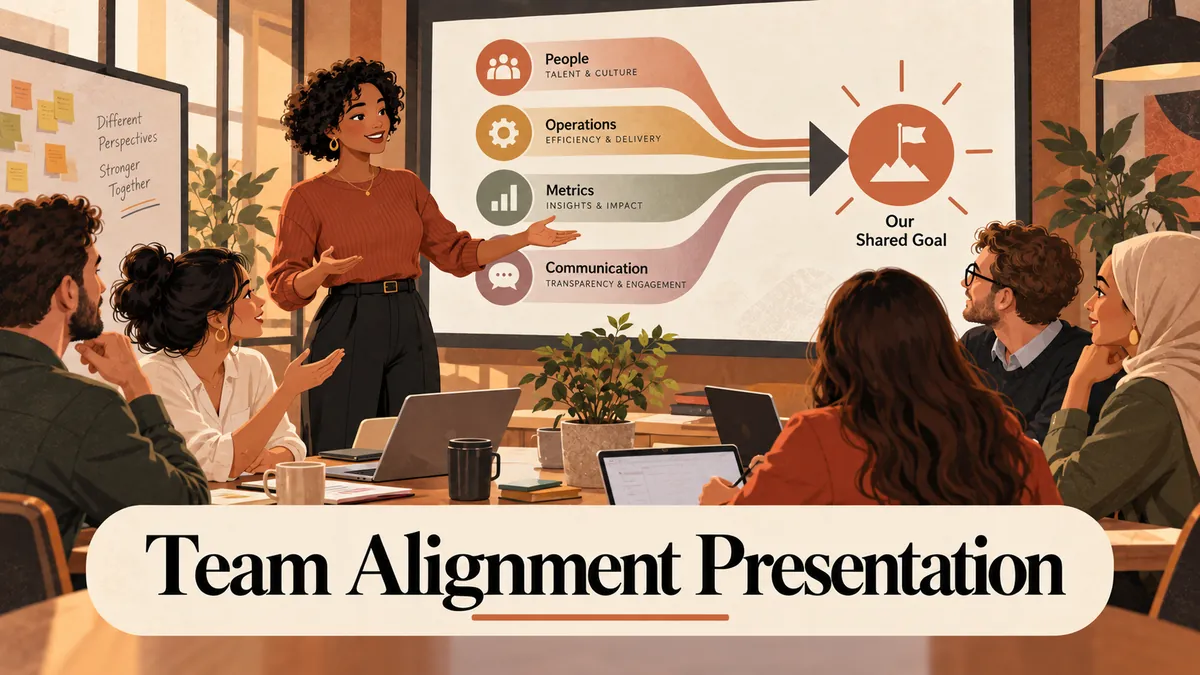
A team alignment presentation helps people agree what matters, how their work connects and what they will do next. Its success is visible in shared priorities and clearer decisions after the meeting. A polished update can still leave a team working towards different goals.
Prepare by identifying the alignment problem: competing priorities, unclear responsibilities, conflicting assumptions or a change that affects how people work together. Then build a presentation that makes that problem discussable and ends with a usable agreement.
Know when alignment is needed
This approach is useful for managers, project leaders, founders and leaders of cross-functional teams. Typical moments include a project kickoff, a change in priorities, a new phase of delivery or a recurring disagreement between functions.
An information update tells people what has happened. An alignment presentation helps them understand what that information means for their work and resolve relevant differences. You may need both, but do not assume that sharing information automatically creates agreement.
Ask what people currently understand differently. Speak with representatives of the affected teams where possible. Separate confirmed concerns from your interpretation of them.
Define what you want the team to do
Your overall objective may be a successful launch. Your presentation intention needs to describe an audience action: “I want the team to agree the launch priorities and name the dependencies that could prevent delivery.”
That is more useful than “I want to explain the plan.” It gives you a way to select content and check whether the meeting worked.
Be clear about decision rights. Which parts of the plan are already fixed? Which parts can this team change? Who resolves an issue that sits outside the room? Inviting input on a decision that cannot change creates avoidable frustration.
Build a shared picture before presenting the plan
Explain the context people need to understand the priorities. Include the objective, relevant constraints and the reason for acting now.
Consider a hypothetical team preparing a product launch. Sales wants extra features for a customer opportunity, engineering needs a stable scope and support needs time to prepare. “Everyone must work harder” does not address the conflict. A clearer message might be: “For this launch, reliability and customer readiness take priority; additional features will be evaluated for the next release.”
The message needs an explanation. What evidence supports the priority? What is the consequence of adding work now? What exceptions are possible, and who can approve them?
A useful priority also names what will receive less attention. Without that trade-off, people may hear several goals as equally urgent.
Use a structure that leads to agreement
Organise the presentation around six questions:
- What are we trying to achieve?
- What has changed or is getting in the way?
- Which priorities should guide our choices?
- How do responsibilities and dependencies connect?
- What needs discussion or a decision today?
- What happens next, and how will we check progress?
Use a simple diagram when it clarifies a handover or dependency. A dense organisation chart rarely explains where work gets stuck. Show who needs what from whom and by when.
Keep the distinction between a proposal and an agreement visible. Label a proposed timeline as proposed until the responsible people have confirmed it.
Create room for useful disagreement
“Any questions?” can produce silence without revealing whether people interpret the plan differently. Ask a more specific question: “Where does this priority conflict with work already committed?” or “Which dependency have we missed?”
Allow time for people to think. For a large or remote group, offer a written channel as well as spoken contributions. Check whether quieter participants have a relevant perspective without forcing them to perform in public.
When concerns emerge, distinguish a clarification from a disagreement or a resource problem. Explain what can be resolved now and what needs a separate conversation. Do not treat every unresolved issue as resistance.
Ask team members to describe the practical consequence: “What would your team do differently next week under this plan?” Their answer gives you more useful information than a general request for agreement.
Deliver with clarity rather than false certainty
State priorities in short, complete sentences. Pause after a significant change so people can understand its implications. Use your voice to distinguish a firm constraint from an open question.
A leader can be clear about direction while acknowledging uncertainty. “The delivery date is fixed; the sequencing of these tasks is still open” gives people more useful boundaries than an overly confident promise.
Rehearse aloud with a colleague who knows a different part of the work. Ask them to interrupt when responsibility, timing or terminology is unclear. In an online meeting, check that the shared plan is readable and that discussion does not disappear behind the slides.
Prepare a one-page alignment brief
Write short answers, then expand where the team needs detail:
- What shared outcome are we working towards?
- What are the priorities, and what are we deliberately postponing?
- What do I want this team to agree or do in the meeting?
- Where do responsibilities or dependencies remain unclear?
- Which decisions are fixed, and which are genuinely open?
- How will we know whether the agreement is working?
Test the brief by asking someone to explain the priorities and their own next action back to you. If their interpretation differs, revise the message before adding more slides.
Turn the meeting into a working agreement
Finish by recording decisions, responsibilities, dependencies and unresolved issues. Confirm dates with the people accountable for them. Name who will resolve remaining questions and when the team will review progress.
Send a concise written version. The agreement may need to change as new information appears; give people a way to raise that information. Alignment is maintained through decisions and follow-through, not through one successful presentation.
If an important team presentation is approaching, explore High-Stakes Presentation Coaching to prepare a message your team can use in its work.
Related preparation guides
Free · ~5 min
How ready is this presentation, really?
- A readiness score across 7 key areas
- A full, personalised report
- A practical exercise to start with
- Just your email — no account, ~5 minutes